
Water Your Lawn Better Than Your Neighbor—Yes, It’s a Competition

If you’ve ever stood outside with a garden hose wondering if you’re blessing your grass or slowly drowning it, welcome — you’re in the right place. Watering a lawn sounds simple… until you actually try to do it. Suddenly you’re standing there like a confused contestant on a reality show, second-guessing everything.
You start Googling things like:
“Why is my lawn crispy?”
“Is three hours too long to run a sprinkler?”
“Why does my neighbor’s lawn look better when he clearly has no idea what he’s doing?”
Don’t worry. This guide will walk you through how to water your lawn correctly without destroying your grass, blowing up your water bill, or embarrassing yourself when the HOA drives by. And yes — it will be funny. Because lawn care deserves personality.
Why Watering a Lawn Is Weirdly Complicated
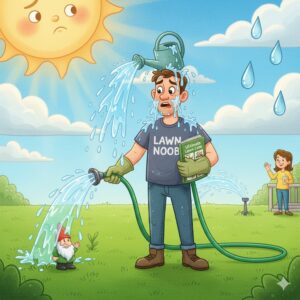 Watering grass is not like watering plants. Plants droop dramatically. Grass stays silent like it’s in a toxic relationship. It suffers quietly, browns quickly, and refuses to tell you what’s wrong.
And because grass can’t text you “I’m thirsty,” most people guess — and usually guess wrong.
Here’s the harsh truth:
Most lawns in America are either chronically dehydrated or drowning. There is no middle ground.
Grass is dramatic like that.
But by the end of this article, yours won’t be.
How Much Water Does Your Lawn Actually Need?
Most lawns need 1 to 1.5 inches of water per week.
Not per day.
Not “whenever you remember.”
Per week.
Think of it like giving your lawn a weekly paycheck. Pay on time, pay the right amount, and nobody complains.
If you’re thinking, “Okay but how do I measure inches of water without becoming a meteorologist?” — here’s the easiest method:
✔️ The Tuna Can Trick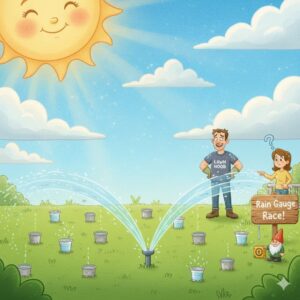
It works, it’s accurate, and yes — you’ll look slightly unhinged doing it.
- Place 3–5 empty tuna cans around your yard.
- Run your sprinkler for 15 minutes.
- Measure the water inside.
If your cans show:
- ¼ inch → You need ~45 more minutes this week
- ½ inch → You need ~30 more minutes
- 1 inch → Perfect. You win.
Low-tech. Reliable. Tuna-scented. Iconic.
The Best Time to Water Your Lawn
Early Morning (Before 10 AM)
This is the Beyoncé of watering times.
Low wind, mild temperatures, and your lawn actually absorbs the water instead of letting it evaporate into the sky like a sacrifice.
Afternoon
No. The sun will steal your water like a thief in the night.
Nighttime
Absolutely not.
Watering at night guarantees fungus. Your lawn becomes a full science experiment.
Early morning is the only correct answer.
Common Watering Mistakes (We Are Fixing These Today)
 1. Watering every day
Your grass is not a houseplant or a toddler.
Daily watering suffocates roots and creates weak, shallow growth.
2. Watering for too long
If your lawn looks like it’s preparing for the synchronized swimming Olympics, please stop.
3. Refusing to adjust for seasons
Summer: more.
Fall: less.
Winter: none.
Frozen grass does not need hydration.
4. Watering in windy weather
Your water will hydrate everything except your actual lawn.
5. Trusting rain
Light rain is useless.
A sprinkle is just sky glitter — looks pretty, does nothing.
Season-by-Season Watering Guide (Simple + Foolproof)
 🌸 Spring — “Wake-Up Season”
Your grass is groggy and rebuilding its confidence.
Give it 1 inch per week.
☀️ Summer — “Struggle Season”
Your lawn is tired, hot, stressed, and judging you silently.
Give it 1.5 inches per week, ideally in 2–3 sessions.
🍂 Fall — “Glow-Up Season”
Grass repairs summer damage now.
Give it 1 inch per week until temperatures drop.
❄️ Winter — “Do Nothing Season”
Grass sleeps.
Do. Not. Water.
How to Water Newly Planted Grass (Because Baby Grass Is Dramatic)
Image of a freshly seeded lawn with tiny green sprouts
If your whole yard is new or you recently overseeded, congratulations — you’ve just adopted the most dramatic version of grass. New grass requires a very specific watering routine.
Week 1: Constant Babysitting
Water lightly 2–3 times per day.
The soil should feel like a damp sponge — not mud, not dust.
Weeks 2–3: Still Needy, But Less Intense
Water once per day, but more deeply.
Think of it like sending your lawn to kindergarten — it’s still needy, but learning independence.
Week 4: Becoming a Real Lawn
Water every other day.
Week 5+: Normal Lawn Rules Apply
Switch to the standard 1–1.5 inches weekly.
New grass is high maintenance, but once it matures, it acts like a normal adult and stops needing your attention every six minutes.
How to Tell If Your Grass Is Thirsty
Grass communicates like someone who wants you to guess what’s wrong.
Here are the signs:
✔️ Footprints stay visible
If your prints linger, your grass is begging you for hydration.
✔️ It turns bluish-green
This is its way of saying, “I’m trying… but barely.”
✔️ Blades fold in half
Stress curls — relatable.
✔️ Soil feels dry and crumbly
Like stale crackers.
Types of Watering Tools (Explained Without Boring You)
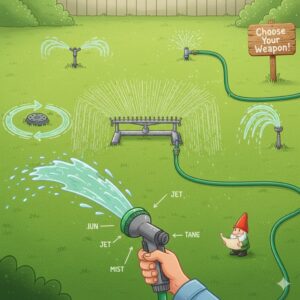 Image of various sprinklers laid out neatly in a row
1. Hose + Nozzle
Affordable, simple, gives you full control.
Perfect for dramatic slow-motion watering moments.
2. Oscillating Sprinkler
The classic “chk-chk-chk” sprinkler.
Great for rectangular yards.
Children will run through it — accept this destiny.
3. Rotating Sprinkler
Covers circles.
Water goes everywhere.
Pure chaos. Very fun.
4. In-Ground Irrigation System
Expensive, bougie, golf-course energy.
Also extremely effective.
How Long It Actually Takes to See Results (Be Patient, But Not Too Patient)
Image showing before-and-after lawn comparison
A greener lawn doesn’t happen after one good watering.
Here’s the REAL timeline:
✔️ 1 Week
Grass perks up a little. Less crunchy. Slightly hopeful.
✔️ 2–3 Weeks
Color deepens. Thinner patches begin filling in.
Your neighbor starts staring out his window.
✔️ 4–6 Weeks
Full transformation mode.
Your lawn is glowing like it just came back from a spa trip.
Consistency is the real secret. Not overwatering. Not guessing.
Consistency.
Smart Watering Tips That Make You Look Like You Know What You’re Doing
- Water deeply, not frequently
- Aerate thick lawns so water can actually reach the roots
- Pause watering if runoff occurs
- Water after fertilizing to help nutrients reach roots
- Adjust your schedule based on weather
These tips make your lawn healthier and your neighbors suspicious.
Sustainable Watering Tips (Save Water + Money)
- Use a smart timer
- Collect rainwater if allowed
- Group plants with similar watering needs
- Adjust watering in shaded vs. sunny areas
- Fix leaks (they steal money quietly)
Saving water doesn’t mean sacrificing results.
It just means watering with intention.
Final Takeaway: Water Smart, Not Hard
Here’s your cheat sheet to out-water your entire block:
- 1–1.5 inches per week
- Water early in the morning
- Adjust for seasons
- Don’t water nightly
- Watch for thirst signs
- Use the right tools
- Be consistent
Follow this guide and your lawn will be greener, healthier, and absolutely brag-worthy.
Your neighbor will wonder what you’re doing.
Let them wonder.
 Lawn Watering FAQ
How long should I run my sprinkler?
Most sprinklers deliver around ⅓ to ½ inch of water in 20 minutes, but every sprinkler is different. The best way to know is the tuna-can test (or any shallow cup you don’t mind sacrificing to science). Run your sprinkler, check the water depth, and adjust. Your lawn deserves accuracy.
Why does my neighbor’s lawn look greener than mine?
Several reasons:
- They may be watering correctly.
- They may be watering illegally at night (don’t do this).
- They might be fertilizing more consistently.
- Or — and this is most likely — they’re using lawn care as personal therapy.
But now that you know the actual watering rules, you’re about to catch up fast.
Is it possible to overwater a lawn?
Absolutely. Overwatered lawns get squishy, smell odd, and develop fungus faster than bread in summer. If your lawn makes a “squelch” sound when you walk on it, congratulations — it’s drowning.
How do I know if I’ve watered too much?
Signs include:
- Standing water
- Mosquitoes filing a change-of-address form
- Mushrooms popping up like unwanted guests
- Grass turning yellow (yes, too much water can do that)
Cut back watering for a week and let things dry out.
Can I water my lawn at night if I live somewhere extremely hot?
It’s still not ideal.
Even in hot climates, fungus thrives at night. If your mornings are scorching by 7 AM, aim for 5–7 AM watering. Yes, that’s early. Yes, it’s worth it.
Does watering during the hottest part of the day burn my lawn?
Contrary to popular myth: the sun will not “burn” your grass through water droplets.
But watering at noon is extremely wasteful — most of the water evaporates instantly. So it won’t burn the grass… but it will burn your money.
Should I water before or after mowing?
After mowing is usually best.
Cut grass dries out faster, so a post-mow drink helps it recover. Just don’t mow a soaked lawn unless you want a mud-slinging workout.
Do different soil types need different watering schedules?
Yes!
- Clay soil: Holds water longer → water less often
- Sandy soil: Drains fast → water more frequently
- Loamy soil: Perfect balance → continue being blessed
If you’re unsure what soil you have, dig a small hole and check texture: sticky = clay, gritty = sand, fluffy = loam.
Is rainwater better than hose water?
For most lawns, yes. Rainwater contains natural nitrogen, is soft, and doesn’t carry minerals that can build up in soil. So if rain ever decides to be helpful, take advantage.
Do sprinkler patterns matter?
Absolutely.
Uneven coverage leads to uneven color. If some patches look like a tropical paradise and others look like a post-apocalyptic wasteland, your sprinkler is missing spots. Adjust, rotate, or upgrade.
How often should I adjust my watering schedule?
Any time the temperature changes by more than 10–15 degrees for more than a week.
Summer heat waves? Water more.
Cooler fall days? Water less.
Random weather chaos? Use judgment. You are now the lawn’s manager.